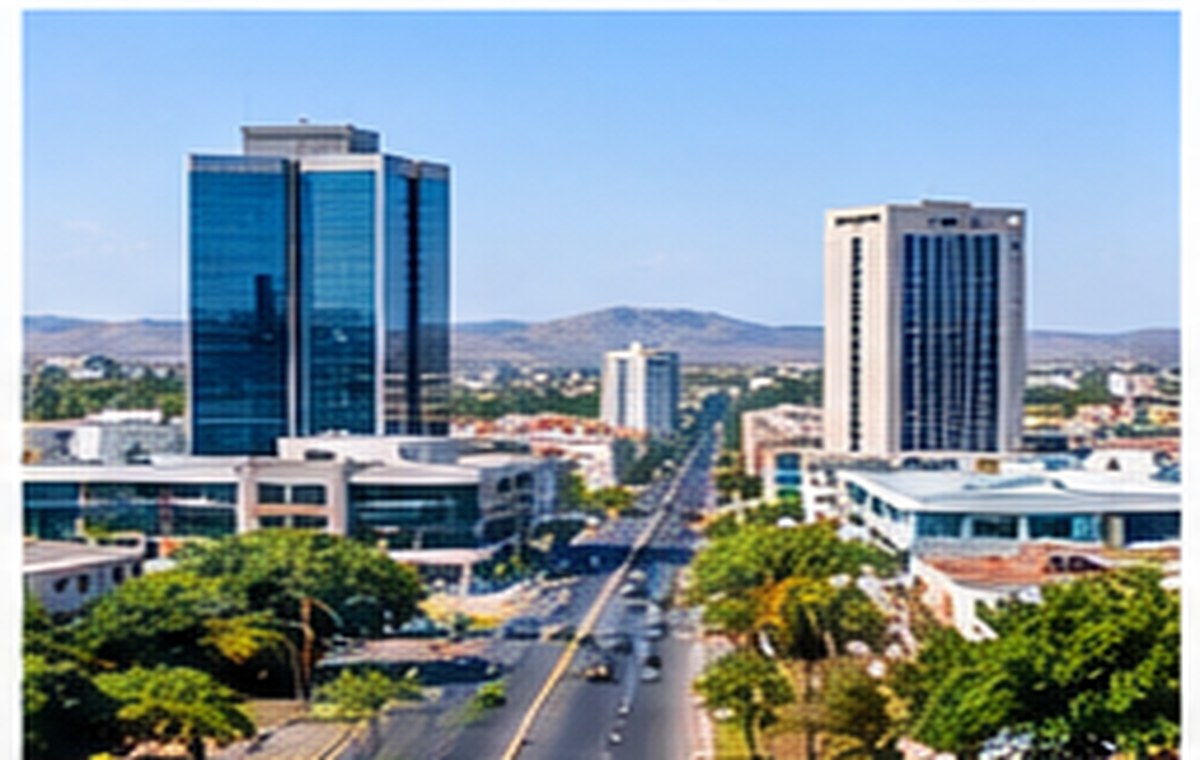
Botswana: financial sector and economic overview is dominated by diamonds, about 80% of exports according to the World Bank, so the 24% fall in mining output in 2024 hit public revenue, reserves and bank liquidity together. The World Bank records a 2.8% GDP contraction in 2024 and an estimated 0.9% decline in 2025, with a rebound of 2.7% forecast for 2026. The Bank of Botswana holds its policy rate at 5.5% in 2026 against 1.9% in 2024, inflation reached 9.3% in August 2026, and the pula (BWP) is managed against a basket including the rand. Nine commercial banks operate.
Why do diamonds weigh so heavily on Gaborone?
Diamonds account for about 80% of Botswana's exports according to the World Bank (2026). When mining output fell by 24% in 2024, according to the IMF, public revenue, foreign exchange reserves and bank liquidity were all hit at the same time.
A recession over two years
The World Bank (Macro Poverty Outlook, April 2026) records a 2.8% contraction in Botswana's GDP in 2024, followed by an estimated decline of 0.9% in 2025. It forecasts a rebound of 2.7% in 2026 and 3.2% in 2027.
The pula and its currency basket
The pula (BWP) is managed against a basket that includes the South African rand. With effect from 11 July 2025, the authorities increased its rate of depreciation and widened the fluctuation band; the IMF then noted an 8.6% fall against the rand.
From 1.9% to 5.5%: the Bank of Botswana's turn
In September 2025 the IMF noted a Monetary Policy Rate unchanged at 1.9% since August 2024. BoBC certificate auction notices from September to October 2026 state a rate "unchanged at 5.5%", a sign of marked tightening in Gaborone.
Inflation above target
On 16 September 2026 the Bank of Botswana published inflation of 9.3% for August, after 9.4% in July. This level exceeds the 3 to 6% range that the IMF associates with its medium-term objective.
Public debt: a rapid jump
According to the World Bank, Botswana's public debt rose from 22.5% of GDP in 2023 to 29.3% in 2024, with 44.3% projected for 2026. The deficit would be close to 6.5% of GDP in 2025 and 7.1% in 2026.
Reserves and the current account
In September 2025 the IMF estimated Botswana's reserves at about five months of imports. The current account swung from a surplus of 1.5% of GDP in 2023 to a deficit of 4.2% in 2024, reflecting the fall in diamond sales.
What does S&P say about the sovereign?
According to a Bank of Botswana statement of 11 September 2026, S&P Global Ratings affirmed Botswana's rating at BBB-/A-3, with a negative outlook. The country remains investment grade, but the negative outlook signals a risk of downgrade.
Nine commercial banks under the central bank's authority
The Bank of Botswana directory at 31 December 2024 lists nine licensed commercial banks, including Absa, First National Bank, Stanbic and Bank Gaborone. Details of the institutions are in banks and the financial sector in Botswana.
NBFIRA: insurance, pensions and micro-lending
NBFIRA supervises insurers, pension funds and non-bank lenders, which held 54% of the 298.9 billion pula of financial assets in 2023. Pension funds carry great weight there, as explained in insurance and the financial market in Botswana.
Botswana Stock Exchange: which banks are listed?
The Gaborone BSE lists Access Bank Botswana, ABSA Bank of Botswana, First National Bank Botswana and Standard Chartered Botswana, among others. For a comparison with a neighbour that has a different exchange rate regime, see the overview of finance in Namibia.
Poverty and IMF recommendations
The World Bank puts poverty in Botswana at 20.1% in 2025, at the 3 dollars a day line. IMF report No. 25/325 of December 2025 details the expected adjustment; the list of African banks places Gaborone in the continental landscape.
Key financial institutions in Botswana
- Bank of Botswana: Central bank in Gaborone; sets the Monetary Policy Rate, manages the pula and licenses commercial banks.
- NBFIRA: Regulatory authority for non-bank financial institutions: insurers, pension funds and micro-lenders in Botswana.
- Botswana Stock Exchange (BSE): National stock exchange where several banks, the BIHL group and Letshego Holdings are listed.
- Botswana Savings Bank: Public savings bank listed among the country's development finance institutions.
Lenders in this country
- Banco Angolano de Investimentos (BAI): Angolan commercial bank granting home loans to individuals and vehicle loans to companies, alongside its wider range of banking services.
- Banco BAI: Angolan commercial bank offering credit to businesses and individuals, including salary-backed loans and online personal credit through BAI Directo.
- Banco de Fomento Angola (BFA): Angolan commercial bank offering products such as home loans and car loans, with detailed technical information sheets for each credit product.
Following Botswana's economy step by step
- Check Bank of Botswana statements every month for inflation, the Monetary Policy Rate and BoBC certificate auctions.
- Read the Bank of Botswana Monetary Policy Report, whose August 2026 edition analyses inflation and growth prospects.
- Compare the debt and deficit projections in the World Bank Macro Poverty Outlook with the IMF Article IV report.
- Track the pula against the rand and the dollar, since its rate of depreciation was raised in July 2025.
- Follow the results of banks and BIHL published on the Botswana Stock Exchange website.
- Watch rating agency announcements relayed by the central bank, notably the negative outlook assigned by S&P.
Botswana's financial indicators
| Indicator | Value | Source and date |
|---|---|---|
| Policy rate (MoPR) | 5.5% | Bank of Botswana, Sept.-Oct. 2026 |
| Annual inflation | 9.3% | Bank of Botswana, August 2026 |
| GDP growth | -0.9% (2025, est.); +2.7% (2026, forecast) | World Bank, April 2026 |
| Public debt | 44.3% of GDP (2026, projection) | World Bank, April 2026 |
| Foreign exchange reserves | about 5 months of imports | IMF, September 2025 |
| Sovereign rating | BBB-/A-3, negative outlook | S&P, statement of 11 Sept. 2026 |
Official publications to consult
- Bank of Botswana Monetary Policy Report (August 2026)
- Inflation releases and BoBC auction notices
- Directory of financial institutions operating in Botswana (2024)
- NBFIRA 2024 annual report
- IMF Article IV report No. 25/325 (December 2025)
- World Bank Macro Poverty Outlook for Botswana (April 2026)
Common misreadings of Botswana's economy
- Believing the policy rate is still 1.9%: that level dates from August 2024, whereas the central bank shows 5.5% in 2026.
- Assuming the pula follows the rand at a fixed parity, like the Namibian dollar, when it is managed against a currency basket.
- Judging the country's solvency on its 2023 debt without taking account of the sharp rise projected for 2026.
- Forgetting that non-bank institutions, especially pension funds, hold more than half of the country's financial assets.
- Relying on unofficial exchange rates rather than the rates published by licensed banks and the Bank of Botswana.
Botswana: your questions on finance
What is the Bank of Botswana policy rate in 2026?
BoBC auction notices published from September to 6 October 2026 show a Monetary Policy Rate unchanged at 5.5%. The IMF still put it at 1.9% in September 2025, which reflects significant tightening whose intermediate steps are not detailed here.
Why is inflation so high in Botswana?
The Bank of Botswana measured 9.3% in August 2026, above its objective. The faster depreciation of the pula decided in July 2025 in principle makes imported goods dearer; the central bank sets out its own analysis in its Monetary Policy Report.
Is the pula pegged to the South African rand?
No. The pula is managed against a basket of currencies that includes the rand, with a scheduled rate of depreciation and a fluctuation band widened in July 2025. The Namibian dollar, by contrast, is pegged to the rand one to one.
What is Botswana's public debt?
The World Bank estimates it at 29.3% of GDP in 2024, against 22.5% in 2023, and projects 39.5% at the end of March 2026 and then 44.3% for 2026 as a whole. The IMF also noted a 24% fall in mining output in 2024.
Which banks are listed on the Gaborone stock exchange?
The Botswana Stock Exchange lists Access Bank Botswana, ABSA Bank of Botswana, First National Bank Botswana and Standard Chartered Botswana, among others. The insurance group BIHL and Letshego Holdings are also listed there, in the financial services sector.
Official sources
FMI – mission article IV Botswana 2025imf.org
Banque mondiale – Macro Poverty Outlook Botswanathedocs.worldbank.org
FMI – rapport article IV Botswana 2025imf.org