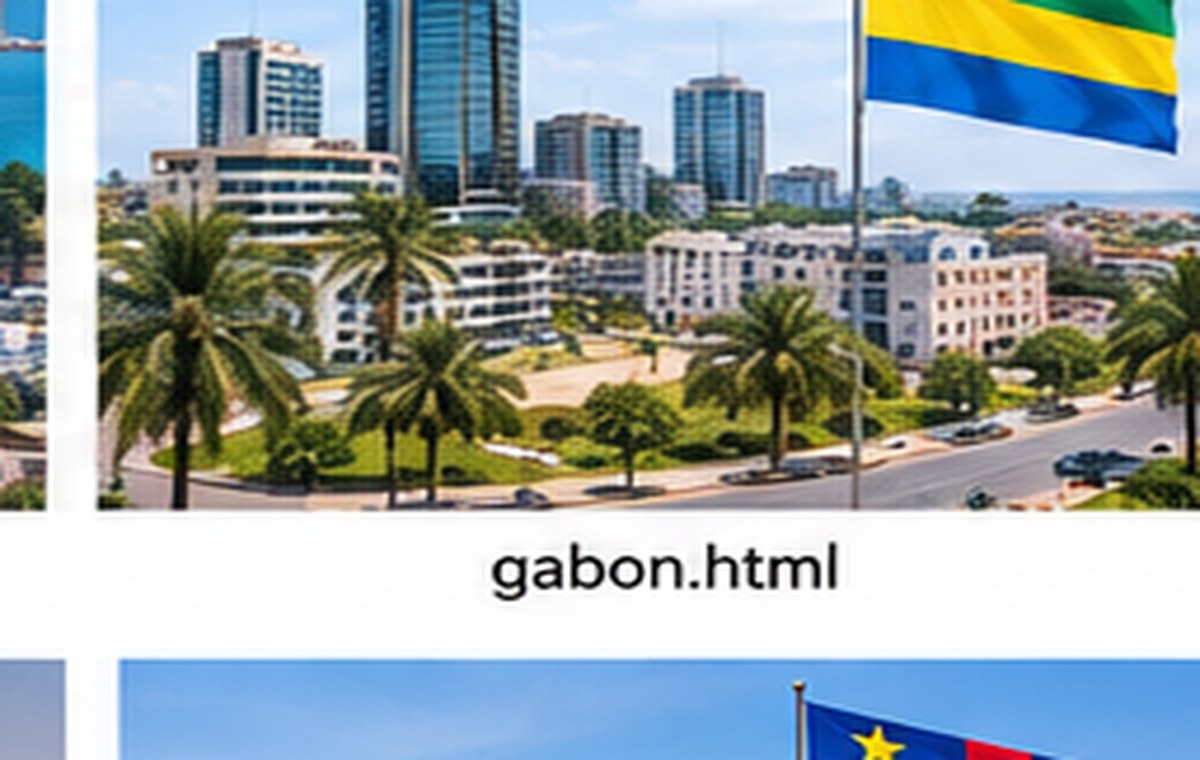
Gabon financial sector and economic overview describe a CEMAC member in the Central African Monetary Union, using the Central African CFA franc (XAF) issued by the BEAC, with banks supervised by COBAC, so that policy rates are decided regionally. The AfDB puts growth at 3.4% in 2024 and 2.7% in 2025, expecting 3.0% in 2026 and 3.1% in 2027, with public debt at 78.9% of GDP in 2025. In 2025 oil output fell by 2.9%, mining output by 2.1% and exports by 20.7%. Seven banks were recorded in 2022 and twenty microfinance institutions are licensed.
CFA franc, BEAC and COBAC
Libreville belongs to the Central African Monetary Union: Gabon uses the Central African CFA franc (XAF), issued by the BEAC, and its banks are supervised by COBAC. Policy rates are therefore decided at regional rather than national level.
Modest growth according to the AfDB
The AfDB's African Economic Outlook 2026 puts Gabon's growth at 3.4% in 2024, then 2.7% in 2025. It expects 3.0% in 2026 and 3.1% in 2027, a gradual recovery according to these projections.
Oil, mining and exports in decline
In 2025, Gabon's oil output fell by 2.9% and mining output by 2.1%, according to the AfDB. Exports dropped by 20.7%, a decline that weighs on foreign currency inflows.
Debt at 78.9% of GDP
Gabon's budget deficit widened from 3.8% of GDP in 2024 to 5.3% in 2025, and public debt reached 78.9% of GDP. The sovereign rating, downgraded in December 2025, may weigh on banks holding government securities.
What role for the IMF in Libreville?
An IMF team led by Aliona Cebotari visited Libreville from 25 February to 6 March 2026, with no programme in place. It stressed fiscal prudence, public financial management and governance.
Towards a new programme
After a high-level meeting held in Paris on 17 March 2026, Gabon, Cameroon and Congo agreed to negotiate new programmes with the IMF. Such an agreement often conditions budget support from other donors.
Seven banks, one historical leader
The BEAC's 2022 report counts seven banks in Gabon and 507,153 bank accounts. In February 2019, BGFIBank held 40% of loans, ahead of UGB and BICIG. Players and procedures are detailed in banks in Gabon.
Expensive credit, rising doubtful loans
The AfDB reports a bank lending rate of 16.5% in the first quarter of 2025 and doubtful loans rising from 9.28% to 9.86%. The BEAC rate cut of June 2026 may therefore be only partly passed on to borrowers.
Insurers: BGFI Assurances in the lead
According to the Bulletin de l'Assureur Gabonais, BGFI Assurances, formerly Assinco, generated XAF 22.656 billion in turnover in 2025, ahead of Sanlam Allianz and SUNU Assurances Vie Gabon. Full overview: the insurance market in Gabon.
Highly concentrated microfinance
The Ministry of Economy counted twenty microfinance institutions in the third quarter of 2025; Finam, Loxia, EDG and Express-Union captured 91% of customers. Deposits and loans grew over the quarter despite a slightly smaller customer base.
Unemployment and poverty, the social downside
The AfDB measures unemployment in Gabon at 20.2% in 2025, and 36.3% among young people, with a poverty rate of 33.1%. A large share of the population thus remains outside conventional bank lending.
The Cameroonian neighbour, on another scale
Cameroon, with 19 banks, carries far more weight in the zone, as finance in Cameroon shows. The World Bank has also published its 2025 economic update on Gabon. For a regional view: African finance overview.
Reference institutions for Gabon
- BEAC: Central bank of the CEMAC, issuer of the CFA franc used in Gabon and responsible for policy rates.
- COBAC: Regional banking commission responsible for supervising Gabonese banks and microfinance institutions.
- BGFIBank Gabon: The country's leading bank, a subsidiary of the BGFIBank group, which is headquartered in Gabon.
- BVMAC: Central African Stock Exchange, with a section dedicated to Gabon among the six member countries.
Lenders in this country
- Crédit du Congo: Commercial bank in the Republic of the Congo, part of the Attijariwafa bank group, providing accounts and loans to individuals and companies.
How to follow Gabon's financial conditions
- Read the AfDB's economic outlook for Gabon, which details growth, inflation, debt and banking indicators.
- Consult IMF statements, including the one of 6 March 2026 on the mission conducted in Libreville.
- Follow BEAC decisions on the tender rate and the reserve requirements applicable to Gabonese banks.
- Check the licence of a bank or microfinance institution with COBAC or the Ministry of Economy before any deposit.
- Compare loan offers in Libreville and Port-Gentil by asking for the annual percentage rate and all ancillary fees.
- Read the Gabonese business press, such as Le Nouveau Gabon or Gabon Media Time, for recent rankings.
Gabonese indicators to remember
| Indicator | Value | Source and period |
|---|---|---|
| GDP growth | 3.0% (2026 forecast) | AfDB, 2026 |
| Inflation | 3.1% (2026 forecast) | AfDB, 2026 |
| Public debt | 78.9% of GDP | AfDB, 2025 |
| Bank lending rate | 16.5% | AfDB, Q1 2025 |
| Doubtful loans | 9.86% | AfDB, latest published figure |
| Account maintenance fees | Variable | Each bank's price list |
Useful reports on the Gabonese economy
- AfDB African Economic Outlook, Gabon country note
- IMF end-of-mission statements
- World Bank 2025 economic update
- BEAC report on payment services
- Bulletin de l'Assureur Gabonais
- Economic dashboard published by the DGEPF
Mistakes to avoid in Gabon
- Assuming that the BEAC rate cut immediately lowers the cost of a loan: in Gabon, the average bank rate reached 16.5% in early 2025.
- Depositing money with an entity missing from the list of twenty licensed microfinance institutions: the authorities have called for impostors to be reported.
- Overlooking sovereign risk: the downgrade of Gabon's rating in December 2025 may affect government securities and the banks holding them.
- Paying upfront fees to a so-called lender contacted online, with no licence verifiable with the monetary authorities.
- Using informal money changers in Libreville, with no receipt or recourse in the event of counterfeit notes or an abusive rate.
Questions on Gabon's economy and finance
What is Gabon's economic growth in 2026?
The African Development Bank forecasts growth of 3.0% in 2026, after 2.7% in 2025, then 3.1% in 2027. The decline in oil and mining output in 2025 explains this slowdown.
What is the level of Gabon's public debt?
According to the AfDB, Gabon's public debt reached 78.9% of GDP in 2025, with a budget deficit of 5.3% of GDP. The country's sovereign rating was downgraded once again in December 2025.
Does Gabon have an IMF programme?
The IMF mission to Libreville in early 2026 did not concern an ongoing programme. In March 2026, however, Gabon agreed, together with Cameroon and Congo, to negotiate a new programme with the Fund.
How many banks does Gabon have?
The BEAC's 2022 payment services report lists seven banks in Gabon and 507,153 bank accounts. BGFIBank, UGB and BICIG accounted for nearly 80% of loans in 2019.
Which currency is used in Gabon?
Gabon uses the Central African CFA franc (XAF), issued by the BEAC for the CEMAC countries. The banknotes are shared with Cameroon, Congo, Equatorial Guinea, the Central African Republic and Chad.
Official sources
BAD – Perspectives économiques du Gabonafdb.org
FMI – visite des services au Gabon, mars 2026imf.org
Banque mondiale – Note de conjoncture Gabon 2025banquemondiale.org
Journal du Cameroun – décisions BEAC de juin 2026fr.journalducameroun.com